
Meg’s Gift Helps Heal
Gift Helps Heal War Survivors & Rescued Dogs in Northern Uganda
For more than twenty years, Meg had studied one question: why does a hand on a dog’s fur calm us down?
Meg was the child who ran towards the dogs everyone else ran from. She grew up in a New York City housing project that didn’t allow pets, and the only dogs she knew were the fierce-looking guard dogs patrolling the tougher streets nearby. Meg buried her face in theirs. They never bit her, and she somehow knew they wouldn’t.
Adults told her parents she had “a way with animals.” She had no idea what that meant, only that it felt good to hear.
A question nobody could answer
Meg started as a television producer, making films for National Geographic, Discovery and PBS. During one project, a psychiatrist told her that people’s heart rates and blood pressure dropped when they talked to their pets. When she asked why, nobody had an answer. The next day she read an article about oxytocin, the hormone behind the bonds between mothers and children. She wondered whether the same chemistry connected people and animals. That question changed her career. Fifteen years of research became her 2009 book, Made for Each Other: The Biology of the Human-Animal Bond. In 2011 she joined Warrior Canine Connection at Walter Reed, where US veterans with combat trauma train service dogs.
A call from Sarah
In 2017 the phone rang. It was Sarah Schmidt, the President, Executive Committee The BIG FIX Uganda. She had heard of Meg’s work and wanted to tell her about something happening in Gulu, Northern Uganda. Since 2012, The BIG FIX had run the region’s only veterinary hospital, offering free care and rabies prevention. But Sarah had seen that the dogs’ suffering was tied to the people’s. After a twenty-year war, survivors of the Lord’s Resistance Army, many abducted as children and forced to become child soldiers, came home to communities that shunned them. In that same society, dogs were guards and hunting partners, rarely cherished and often abused.
The Comfort Dog Project grew from that insight. It was inspired by community psychologist Francis Okello Oloya, who was blinded at 12 during the war. At boarding school, two neighborhood dogs began guiding him to the latrine each night when they heard his cane. The dogs showed him a kindness most people around him never saw.
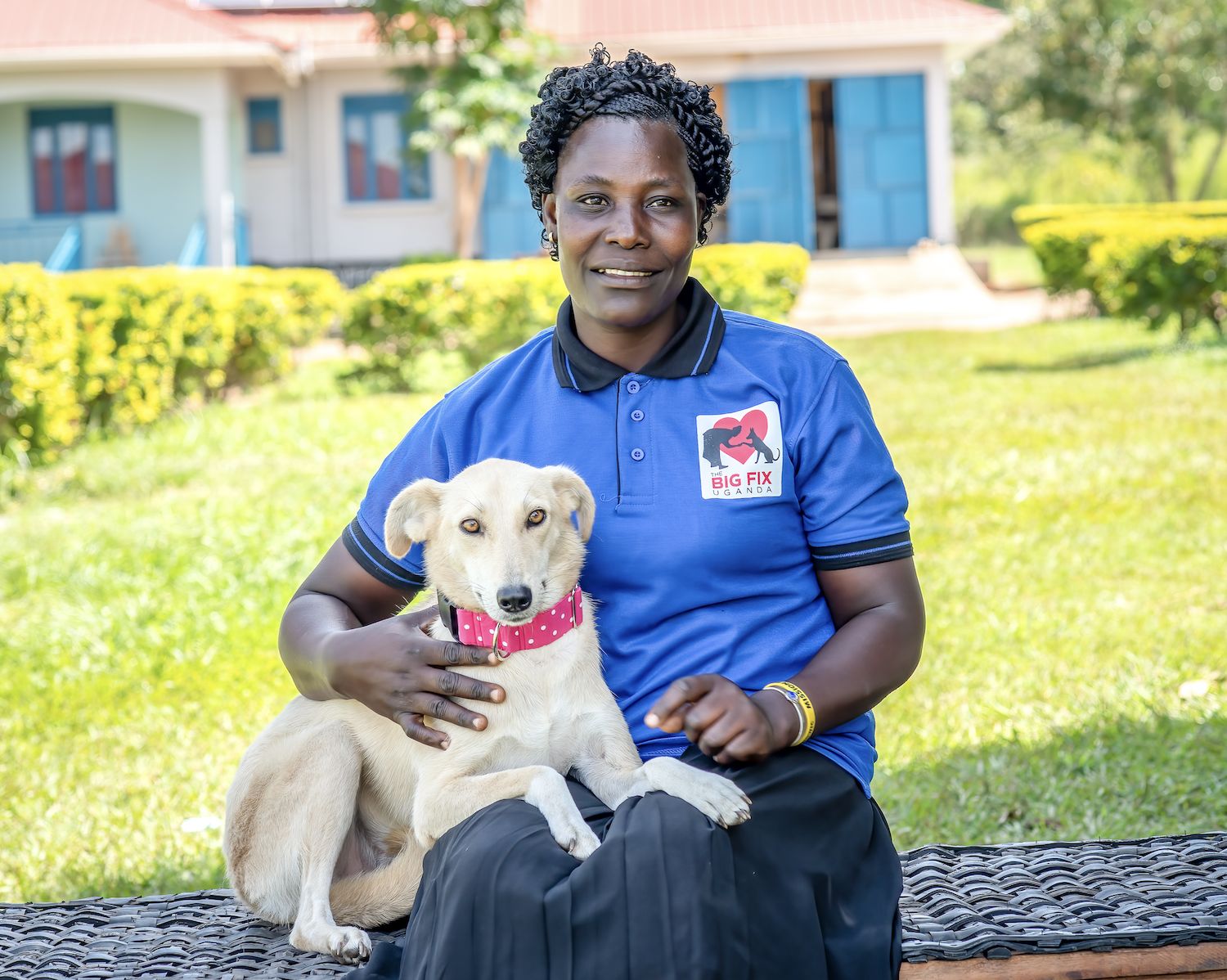
Today, for more than ten years, the project has paired war-trauma survivors with rescued dogs. Over 20 weeks, trauma counselling is combined with lessons in feeding, caring for and training a dog, so that people who may never have touched a dog kindly learn to build a bond with one. Of the first 59 Guardians who graduated, assessments showed reduced PTSD symptoms and better wellbeing, for the people and for their dogs. Graduates have gone on to work as field educators at mobile clinics, in schools and on the radio.
When Meg flew to Uganda to see it for herself. She came back with a different understanding of her own subject. Genetic studies suggest Northern Uganda’s dogs are among the most ancient on Earth, never domesticated and never befriended. Here were people who had never been befriended by dogs, and dogs who had never been befriended by people, finding each other. To Meg, it fills a gap in the story of how dogs entered our lives. They didn’t only guard us and help us hunt; they also helped heal us. She says simply, “I am now a different person.”
She has written that the project “stretches the limits of anything I had ever thought possible,” a striking admission from someone who has spent a career mapping the neuroscience of this bond.
Why she keeps giving
When someone who has spent a lifetime studying the human-animal bond chooses to give to one programmed, it’s worth asking why. Meg’s reasons are simple.
For Meg, the Comfort Dog Project is her book come to life. It brings together everything that has driven her: the science of the bond, the healing power of dogs, and the people who need both. At Walter Reed she had seen what happens when people carrying trauma work with dogs. Then she heard that The BIG FIX was pairing war survivors in Northern Uganda with rescued dogs who needed them just as much, and she knew she had to support it. Today she sponsors several Comfort Dog Project members herself, helping each of them through the program alongside a rescued dog of their own.
Meg believes this program has to be scaled up, so that many more survivors and rescued dogs can find each other.
For Meg, giving is the last link in the chain. The science explains why the bond works; donations let it keep happening for the next survivor and the next dog.
